
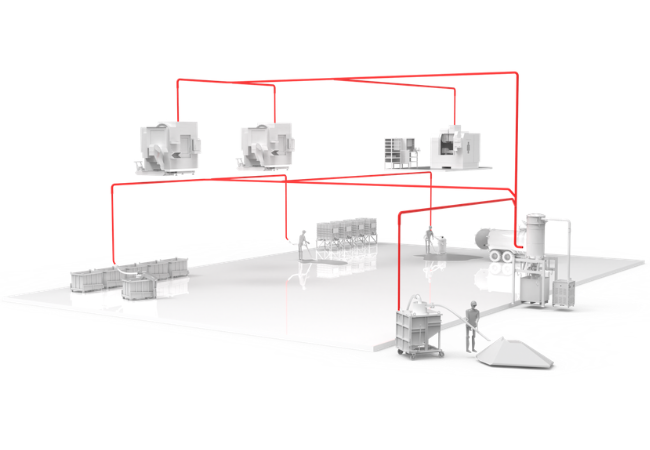
When we talk about industrial vacuuming, we often think of a mobile vacuum cleaner used to clean a workstation, machine, or specific area of a department. It's an effective solution in many contexts, especially when the need is localized and limited.
But when the dust affects multiple points in the plant , distances increase, and the aspirated material must be collected, disposed of, or recovered in a more organized manner, the approach changes.
This is where CVS comes in, the name chosen by Delfin to identify its centralized extraction systems. Not a single machine, but a system designed to connect multiple collection points and integrate dust management into the production process.
Here are 5 useful curiosities to better understand what CVS means and why it can become a strategic solution for many industrial environments.
1. CVS is the Delfin name for centralized vacuum systems
The first curiosity concerns the name itself.
With CVS, Delfin identifies its centralized extraction systems: solutions designed to manage industrial dust in a more structured way than point extraction.
The CVS was designed to serve departments where extraction no longer concerns a single workstation, but multiple work areas, operators, or machines. The system connects multiple collection points via a network of pipes and conveys the extracted material to a collection point.
In this way, dust management becomes part of the production organization and not just a post-processing intervention.
2. A CVS is not a single machine, but a complete system
A Delfin centralized system should not be considered as a large vacuum cleaner.
A CVS is made up of several elements that work together: central vacuum unit, filter unit, piping, automatic control panel, sensors, exhaust systems and, where necessary, additional components for collecting or managing the vacuumed material.
Each component has a specific function. The power unit generates the necessary vacuum, the filter unit separates dust from the air, the pipes connect the various suction points, and the collection systems allow for orderly material management.
For this reason, the choice of a CVS is not based only on the power of the central vacuum unit, but on the analysis of the entire system.
3. Can connect multiple suction points in the same department
One of the reasons why a company evaluates a centralized system is the presence of multiple suction points.
When operators need to vacuum in different areas, when machinery generates dust in multiple locations , or when significant distances need to be covered, a mobile solution may no longer be sufficient to manage the process in an orderly manner.
The CVS allows for the organization of a fixed network of pipes connected to collection points. The aspirated material is conveyed to a specific point, facilitating collection, disposal, or recovery.
This configuration can help make dust management more controlled and department organization more consistent.
4. Design starts from the process, not the product
Each Delfin centralized system is designed based on the actual needs of the facility.
To define a correct configuration, it is necessary to evaluate several factors: number of suction points, distance between the stations, length of the pipes, required air flow rate, pressure drops, type of dust or residue to be sucked up, method of use and installation constraints.
How operators use the system is also an important factor. A centralized system must integrate with production rates , the department layout , and daily activities .
For this reason, Delfin supports the client from the initial analysis stages, evaluating the application context before defining the most suitable solution.
5. A CVS can be configured according to the needs of the plant
There is no single CVS that applies to every department.
The system configuration can vary depending on the material being aspirated, the number of collection points, the distances to be covered, the collection method, and any control or automation requirements.
Where necessary, the system can integrate automatic control panels, sensors, and exhaust systems designed to facilitate daily plant management. For specific dust types or complex application contexts, specific assessments may be required regarding safety, compliance, and the characteristics of the treated material.
This flexibility allows us to design a solution that is consistent with the production process and real-world conditions of use.
Why consider a Delfin CVS ?
Choosing a CVS means evaluating an industrial extraction system designed to work together with the production process .
It's not just about vacuuming up dust or debris, but organizing their management in a more controlled, orderly, and integrated manner. This approach is particularly useful when vacuuming needs involve multiple areas, multiple operators, or multiple machines.
Delfin supports industries in analyzing needs, designing systems, and identifying the most suitable components for the application context.
Do you have multiple suction points in your department?
Are mobile solutions no longer sufficient to manage dust and residues?
Want to know if a centralized system can be integrated into your production process?