
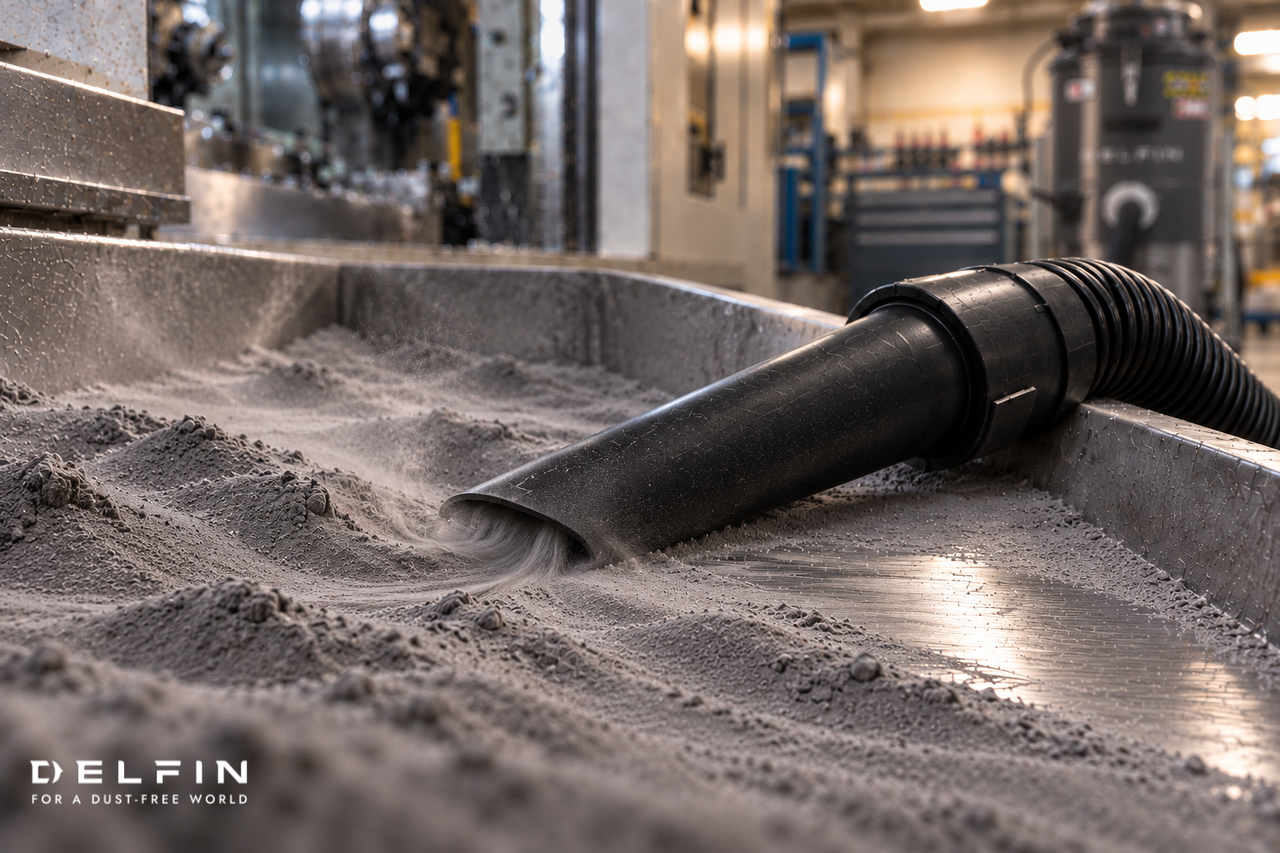
Grinding aluminum, polishing metal parts, or handling metal powders generates fine dust. This dust settles on machinery, enters the air we breathe, and accumulates in hard-to-reach areas. Therefore, anyone wanting to extract metal dust must consider more than just suction power and container volume: depending on the material and process, there can be health hazards as well as fire and explosion risks.
Safe extraction of metal dust requires a hazard assessment, extraction system suitable for the specific type of dust, and appropriate protective measures. These include avoiding effective ignition sources, using suitable conductive components, ensuring reliable filtration, and implementing safe procedures for emptying and maintenance.
Which metal dusts are flammable or explosive?
Not only the metal itself, but also its particle shape determines the hazard. What is inconspicuous as a solid component can pose a fire or explosion risk as fine dust.
Aluminum, magnesium and titanium: reactive metal dusts
Aluminum, magnesium, and titanium can be flammable in finely dispersed form and can create explosive dust-air mixtures. A solid metal component behaves differently than the dust generated during its processing. Fine particles possess a large surface area relative to their mass, on which chemical reactions can occur.
Grinding, brushing, and polishing aluminum, in particular, generates dust whose fire and explosion hazards must be considered. Magnesium dust also requires special protective measures.
Other metal dusts can also be flammable.
The hazard is not limited to light metals. Fine grinding dust from other metals can also be flammable and, under certain conditions, explosive.
Crucial factors include grain size, composition, moisture content, and impurities. Therefore, the safety of metal dust cannot be determined solely from the name of the source material. The actual dust generated, including any admixtures from abrasives, coatings, or processing aids, must be assessed.
When can metal dust explode?
Combustible metal dust does not lead to an explosion under all conditions. The crucial factor is whether an explosive dust-air mixture is formed and an effective ignition source is present.
When dust, air and an effective ignition source come together
A dust explosion can occur when combustible metal dust is sufficiently finely dispersed in air, reaches an explosive concentration, and is ignited by an effective ignition source. Possible ignition sources include hot surfaces, mechanically generated sparks, or electrostatic discharges.
While a dust fire can also affect a deposit, in a dust explosion the combustion spreads rapidly through the stirred-up mixture. Particularly within closed containers or systems, dangerous pressures can build up.
Why do deposits and the inside of the device also count?
Deposited dust can be stirred up again by air currents, cleaning work, or vibrations. A seemingly inconspicuous layer of dust can therefore contribute to a hazard.
The assessment must also include filters, piping, and collection containers. A seemingly clean workspace does not rule out the possibility of an explosive atmosphere inside the extraction system. Even a low average dust concentration does not provide reliable safety because dust is distributed unevenly within a system.
Extracting metal dust: What requirements need to be clarified first?
Selecting a suitable extraction system begins with a careful examination of the material and the work processes. Only when the potential hazards are known can appropriate protective measures be determined.
Hazard assessment and dust properties
Before selecting equipment, it must be determined what hazards the process causes. Based on the hazard assessment, the employer defines the necessary technical and organizational protective measures.
The following questions are particularly relevant:
- Which metal or alloy is being used?
- What particle sizes and dust quantities are produced?
- What are the known combustion and explosion characteristics?
- Does the dust contain any components that are hazardous to health?
- Can sparks, hot particles, liquids, or other substances be absorbed along with it?
If reliable information is lacking, additional information from the material supplier or analysis of a representative dust sample may be necessary. The safety data sheet of the starting material does not necessarily describe all properties of the processing dust.
Cleaning tasks and process extraction differ.
Occasional cleaning of a machine's surroundings presents different challenges than the continuous dust collection required at a grinding machine. An industrial vacuum cleaner picks up accumulated residues. A suitably designed dust collector captures airborne dust as directly as possible at its source.
The nature of the material being vacuumed is also crucial: A vacuum cleaner for metal shavings, for example, must be able to handle sharp-edged shavings and any adhering cooling lubricants. Therefore, a shavings vacuum cleaner is not automatically suitable for fine, combustible metal dust. For this, factors such as filtration, ignition source prevention, and explicit material suitability must be checked.
Anyone in the metalworking industry looking for a "metal chip vacuum" should first determine whether they primarily need to collect coarse chips, fine metal dust, or a mixture of solids and liquids. The amount of dust, operating time, collection element, and required airflow will then determine the appropriate design. High motor power alone does not guarantee suitable extraction.
When is ATEX required when extracting metal dust?
Whether an ATEX-certified vacuum cleaner is required depends on the specific operating conditions. Both the environment surrounding the device and any potentially explosive atmospheres inside it must be taken into account.
Assess areas at risk of explosion and dust zones
ATEX refers to the European framework for explosion protection. The selection of equipment depends crucially on whether and under what conditions a hazardous explosive atmosphere can occur.
The following zones are distinguished for combustible dusts:
Dust zone | Occurrence of a dangerous explosive atmosphere |
Zone 20 | Constantly, over long periods of time, or frequently |
Zone 21 | Occasionally during normal operation |
Zone 22 | Not normally during normal operation, or only briefly. |
If a vacuum cleaner is used in a zone classified accordingly, its equipment category and/or protection level must be appropriate. Additionally, other operating conditions must be taken into account. Zone classification is carried out as part of the operational assessment.
Why “combustible dust” alone does not determine the choice of equipment
The installation area and the interior of the device must be considered separately. Even outside a designated dust zone, hazards can arise inside the vacuum cleaner when collecting combustible dust.
Conversely, an ATEX marking does not automatically mean that a device can handle any type of metal dust. The intended use, the material properties, and the manufacturer's instructions are all relevant. Therefore, suitability for aluminum dust or other reactive metal dusts must be explicitly verified.
What technical protective measures does the extraction system require?
Safe dust extraction requires perfectly matched components. From the suction nozzle to the collection container, they must ensure reliable dust capture and meet the specified protection requirements.
Grounding and conductive components
Electrostatic charges can build up during the transport of dust. If these charges discharge as a spark capable of ignition, this can ignite an explosive mixture.
Therefore, vacuum cleaners, hoses, connectors, and suction tools must be compatible in terms of their electrical properties. TRGS 727 prohibits vacuum cleaners without grounding or a conductive connection between the suction nozzle and collection container from being used in potentially explosive atmospheres or for vacuuming combustible dusts. Using any replacement hose can compromise the intended safety measures.
Avoid ignition sources and check additional protective measures
During grinding, sparks or hot particles can enter the extraction system. Depending on the process, additional measures are required, such as suitable pre-separation. However, a spark separator alone does not guarantee a safe overall system.
The protection concept must first and foremost avoid or limit hazardous explosive mixtures and prevent effective ignition sources. If an explosion cannot be reliably ruled out, suitable measures for structural explosion protection are required.
Assess filtration and explosion protection separately
Dust classes L, M, and H relate to the suitability for holding certain hazardous dusts. They do not replace an assessment of explosion protection.
A HEPA filter alone is not sufficient for handling combustible metal dust. A combination of appropriate filtration, safe device design, and suitable collection is required.
Extracting aluminum dust: dry extraction, wet separation or inerting?
Various separation and containment concepts are suitable for aluminum dust and other reactive metal dusts. The appropriate method depends on the material properties and the conditions of the specific process.
Why wet separation is not automatically safer
In a specially designed wet separation process, particles are separated using a liquid. However, this is not the same as the pickup of metal dust by a conventional wet/dry vacuum cleaner.
Aluminum and magnesium dusts can react with water under certain conditions, releasing hydrogen. This can also create an explosive gas atmosphere. Wet dust collection therefore requires a material-specific plant and operating concept.
How can collection, emptying, and maintenance be kept safe?
Even after extraction, metal dust can still be hazardous. Therefore, collection, emptying, and maintenance must be planned just as carefully as the actual dust collection process.
Select process according to material and application
Whether dry extraction, wet separation, or an inerting concept is suitable depends on the specific dust and process. Inerting aims to reduce reactivity through a suitable medium or a suitably modified atmosphere.
The medium, dosage, operating conditions, and material compatibility are crucial. Simply immersing reactive metal dusts in a liquid bath does not automatically render them harmless. The proven suitability of the system and its intended operating limits are decisive.
Different materials are captured in a controlled manner
Different metal dusts, grinding residues, and other substances must not be mixed in an uncontrolled manner. Separate collection is generally required when processing different materials; any deviations must be assessed as safe within the framework of the risk assessment.
Plan the entire handling of dust
Emptying, temporary storage, and disposal are also part of the safety concept. Collection containers must be suitable for their contents; hazardous dust releases must be avoided.
Filters, hoses, seals, and grounding connections require regular inspection. Operating instructions and training must also explain which materials may be collected and how to proceed in case of malfunctions.
Frequently asked questions about extracting metal dust
Yes. Combustible metal dust, when sufficiently finely dispersed as a dust-air mixture, can be ignited by an effective ignition source and cause a dust explosion.
A hazard assessment and material-appropriate extraction are required. In addition, coordinated measures for ignition source prevention, grounding, filtration, emptying, and maintenance are necessary.
For use in potentially explosive atmospheres, the device must meet the relevant requirements. Additionally, potential explosion hazards inside the device and its suitability for handling dust must be assessed.
An ordinary workshop vacuum cleaner without proven suitability is not a suitable choice. Explicit material approval, operating conditions, and the company's safety concept are crucial.