
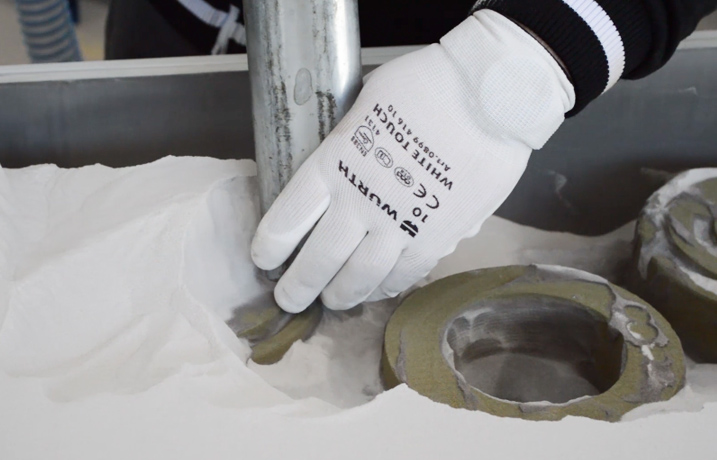
Managing hazardous dust in industrial environments is not simply a matter of choosing an industrial vacuum cleaner. The entire material flow should be considered: from dust generation and source capture to filtration, collection and discharge.
Each application is different. Dust type, particle size, quantity, production process, working environment and operating conditions can all influence the configuration of the extraction solution.
For this reason, before taking action, it is important to assess the process as a whole and identify where, how and in what quantities dust is generated and handled.
What to consider for effective industrial dust management
From safety to production continuity
Dust management requires an approach that combines safety, work organization and production efficiency.
A properly designed solution should help reduce material dispersion and make vacuuming and cleaning activities more controlled and repeatable.
This means assessing not only the machinery, but also the operations carried out by workers. When dust is generated at several stages of the process or tends to accumulate in hard-to-reach areas, isolated measures may not be sufficient.
The final configuration should always be evaluated according to the actual operating conditions of the facility and the regulations applicable in the country where the system is installed.
1. Identify the dust and critical points
Understand the material
The first step is to understand the characteristics of the material being produced, processed or handled.
Relevant parameters may include:
- particle size;
- density;
- quantity;
- material behaviour;
- potential toxicity;
- potential combustibility;
- electrostatic properties;
- temperature and process conditions.
Materials that appear similar can behave very differently during extraction and may therefore require different system configurations.
Dust characterization is therefore a key factor when defining the extraction, filtration and collection system.
Identify where dust is generated
The assessment should follow the dust throughout the production process.
Cutting, grinding, milling, mixing, conveying, dosing, bagging, discharge and cleaning operations can all create very different conditions.
It is therefore useful to identify:
- emission points;
- accumulation areas;
- manual operations;
- material transfer points;
- areas where settled dust may become airborne again.
This analysis helps determine where intervention is required and which technology is most appropriate.
2. Capture dust before it spreads
Act close to the source
Whenever possible, dust should be captured as close as possible to the point where it is generated.
Source capture can help reduce dust dispersion into the surrounding environment and decrease the amount of material that later needs to be removed from surfaces.
Depending on the application, this may involve dust collectors, extraction hoods, suction points or direct connections to production machinery.
Reduce manual transfers
Pouring, emptying and manual transfer operations can contribute to dust dispersion.
Where the process allows it, closed systems or dedicated transfer solutions can reduce intermediate handling stages and move the material directly to its destination.
In these applications, pneumatic conveying may also be considered, especially when the goal is not simply to remove dust but to transfer material as part of the production process.
3. Choose the technology according to the objective
One of the most important aspects is to distinguish between industrial vacuuming, dust collection, centralized vacuum systems and pneumatic conveying.
They do not perform the same function.
Industrial vacuum cleaners
An industrial vacuum cleaner is mainly used to collect settled dust, residues or other materials and can be used for localized cleaning or material recovery operations.
Dust collectors
A dust collector is mainly designed to capture airborne particles directly at the point where they are generated.
It can be connected to production machinery or used with dedicated extraction systems.
Centralized vacuum systems
A centralized vacuum system connects several extraction points to a single vacuum unit.
It can be particularly useful in large facilities, on multiple production lines or wherever vacuuming is regularly required in different areas.
Pneumatic conveying systems
When material needs to be moved from one point of the process to another — for example towards a mixer, feeder, hopper or packaging machine — a pneumatic conveying system may be required.
In this case, the material is not simply collected: it becomes part of the production flow.
Size the system correctly
Airflow, vacuum level, filter surface area, pipe diameter and length, pressure losses, material characteristics and the number of simultaneous extraction points are among the parameters that may influence system sizing.
The solution should also be sized according to the required duty cycle. Occasional cleaning has very different requirements from continuous extraction or a system serving several lines at the same time.
4. Define filtration according to the dust
The filtration system should be selected according to the material characteristics and the containment level required by the application.
Fine, hazardous or particularly critical dust may require specific filtration configurations or multi-stage systems.
Where large quantities of material are involved, it may also be useful to introduce a pre-separation stage.
A cyclonic pre-separator, for example, can separate heavier particles before they reach the main filter, helping reduce the load on the filtration system.
Maintain filtration performance
Selecting the filter is only part of the process.
During operation, the system should be kept within the intended working conditions through appropriate filter-cleaning systems, clogging monitoring and maintenance procedures.
Filter accessibility, replacement procedures and residual material handling should also be considered as part of the overall system design.
5. Plan collection, discharge and maintenance
Prevent dust from being dispersed again
Dust management does not end when the material enters the vacuum system.
The discharge stage can also represent a critical point.
Containers, continuous bagging systems, Big Bags or other collection solutions may be selected according to:
- material quantity;
- dust characteristics;
- discharge frequency;
- containment requirements;
- final material destination.
The objective is to allow material removal while minimizing the risk of renewed dispersion during discharge operations.
Define repeatable procedures
A good system should be easy to integrate into normal production activities.
Accessible extraction points, suitable accessories and clearly defined procedures help operators maintain more consistent cleaning standards.
Maintenance activities should also include checks on piping, filters, collection systems and other key components.
FAQ about industrial dust management
No. The correct technology depends on the objective.
An industrial vacuum cleaner may be used to collect settled material; a dust collector can capture airborne dust; a centralized system can serve multiple suction points; and a pneumatic conveying system can move material from one stage of the process to another.
A centralized system may be suitable when there are multiple extraction points, long distances or a continuous need for vacuuming across different areas of a facility.
Before designing the system, the material, airflow, vacuum level, simultaneous users, piping layout and discharge method should be assessed.
Because density, particle size, behaviour, quantity and other material properties influence how the material can be vacuumed, filtered, separated or conveyed.
For particularly complex applications, material testing can therefore be useful before defining the final configuration.
Effective industrial dust management requires an assessment of the entire process.
Generation, containment, capture, vacuuming, filtration, collection and discharge should be considered as parts of one integrated system.
The most suitable solution always depends on the material, the production process and the operating conditions of the facility.
Delfin develops industrial vacuum cleaners, dust collection systems, centralized vacuum systems and pneumatic conveying solutions that can be configured according to specific process requirements.
The starting point is understanding the material and the actual operating conditions of the application.