
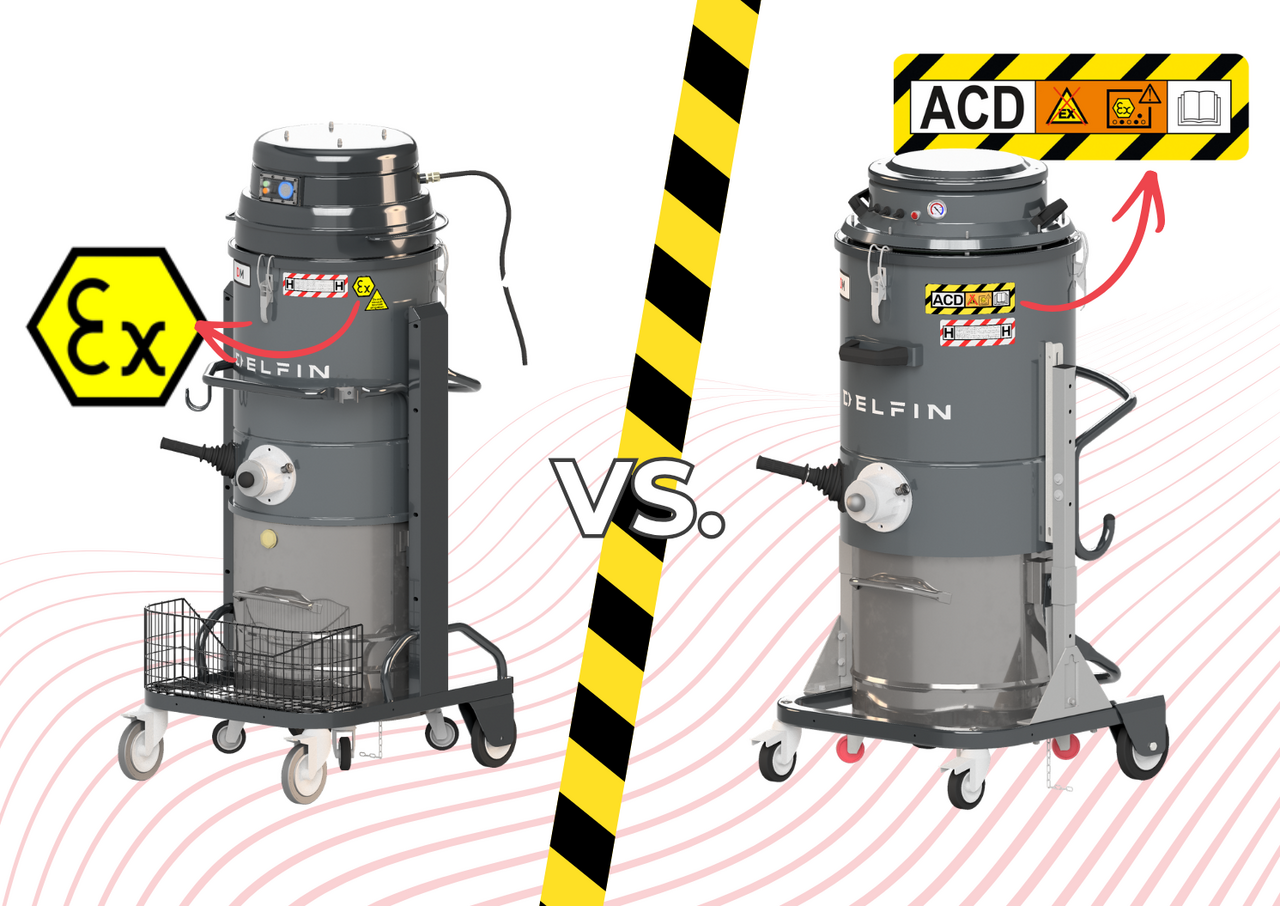
ATEX or ACD: Which industrial vacuum cleaner is suitable for combustible dusts? This question arises in many industrial applications where combustible or potentially explosive dusts are generated. When selecting an industrial vacuum cleaner, it's not just the material, suction power, and filter technology that need to be considered. The environment in which the vacuum cleaner will be used also plays a crucial role. Two terms appear particularly frequently in this context: ATEX and ACD . Both relate to the safe handling of combustible dusts. However, they are not the same and should not be confused when selecting an industrial vacuum cleaner.
Simply put:
- ACD industrial vacuum cleaners are designed for the collection of combustible dusts in areas that are not classified as potentially explosive atmospheres.
- ATEX industrial vacuum cleaners are designed for use in appropriately defined potentially explosive atmospheres and must meet the applicable requirements.
However, in practice, the selection process is not quite that simple.
What does ACD mean in the context of industrial vacuum cleaners?
ACD is used in the context of industrial vacuum cleaners to designate devices designed for collecting combustible dusts . IEC 60335-2-69:2021 contains requirements for commercial wet and dry vacuum cleaners and explicitly addresses machines for collecting combustible dusts in areas that do not present an explosive dust atmosphere . In practice, ACD industrial vacuum cleaners are therefore used particularly for applications where combustible dusts must be safely collected, but the vacuum cleaner itself is located outside of a classified potentially explosive atmosphere .
A typical scenario might look like this:
Combustible dust is generated in a production area. Under certain conditions, the area where the dust originates may be classified as potentially explosive. However, the industrial vacuum cleaner is positioned outside this classified area. Using suitable accessories designed for the application, the dust is collected from the relevant location. Precise application design is crucial here.
What does ATEX mean?
ATEX stands for "Explosive Atmospheres" and refers to the European legal framework for equipment and protective systems intended for use in potentially explosive atmospheres. Directive 2014/34/EU is particularly relevant for equipment and protective systems. Therefore, ATEX is not simply about whether a device can collect combustible dust. It is also crucial whether and where an explosive atmosphere may be present .
For combustible dusts, zones 20, 21 and 22 are distinguished.
- Zone 20: Explosive dust atmosphere is present constantly, for long periods or frequently.
- Zone 21: Explosive dust atmospheres may occasionally occur during normal operation.
- Zone 22: An explosive dust atmosphere does not normally occur during normal operation; if it does occur, it is rare and lasts only a short time.
Gases, vapors, and mists are classified into zones 0, 1, and 2. This zone classification is an important basis for determining which equipment may be used in a given area.
The crucial difference: Where is the industrial vacuum cleaner located?
When distinguishing between ACD and ATEX, one question is therefore particularly important: Is the industrial vacuum cleaner itself located in a potentially explosive atmosphere? This is one of the key factors in the selection process.
Case 1: The industrial vacuum cleaner is located outside the Ex zone.
If combustible dust needs to be collected, but the industrial vacuum cleaner itself is located outside a classified potentially explosive atmosphere , an ACD industrial vacuum cleaner may be the appropriate solution, depending on the specific application. IEC 60335-2-69:2021 addresses equipment for combustible dusts in areas outside of an explosive dust atmosphere.
Case 2: The industrial vacuum cleaner is located within an explosion-proof zone.
If the industrial vacuum cleaner itself is located in an area classified as potentially explosive, the requirements for use in this zone must be considered. In such cases, a suitably designed or certified ATEX industrial vacuum cleaner may be necessary. Therefore, an ACD vacuum cleaner is not automatically a substitute for an ATEX industrial vacuum cleaner .
ACD or ATEX: A direct comparison
| feature | ACD industrial vacuum cleaner | ATEX industrial vacuum cleaners |
| Collection of combustible dusts | Yes, for appropriately suitable Applications | Yes |
Use outside classified areas | Typical area of application | Possible, depending on the design |
| Use within an ATEX zone | Not generally permissible | In accordance with the approval and labeling |
Site at risk of explosion | Not the typical use case | Must be appropriate for the respective zone |
| basis | ua IEC 60335-2-69 | ATEX requirements and, depending on the device, further requirements relevant standards |
Zone assignment | Not as a substitute for zone approval | Zone and device category must match |
| Typical application | Combustible dusts outside classified areas areas | Extraction in appropriately classified areas explosion-prone areas |
Important: The suitability of a device cannot be determined solely based on the designation "ACD" or "ATEX". The suction medium, zone, installation location, accessories, and operating conditions must all be considered together.
Can an ACD vacuum cleaner pick up dust from an ATEX zone?
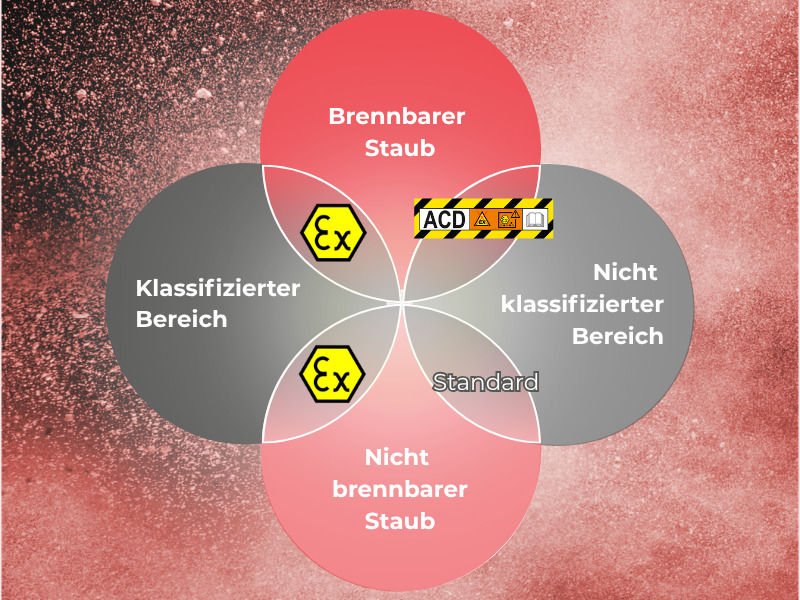
This can be a possible application if the ACD vacuum cleaner is positioned outside the classified zone and the entire setup, including hose, nozzle, and other accessories, is suitable for this purpose. This distinction is crucial in practice. For example, the dust might be located within a classified area, while the industrial vacuum cleaner is positioned outside of it. In this case, two different aspects must be considered:
Where is the suction medium located?
and
Where is the device located?
These two questions must not be confused. If an industrial vacuum cleaner is to be operated within an ATEX zone, it must be verified whether the specific device is suitable for the corresponding zone, atmosphere, and application. For mobile electric vacuum cleaners used to collect combustible dust in an explosive dust atmosphere, there is a separate standard, IEC 62784 , which specifies requirements for devices with Equipment Protection Level Dc and supplements or modifies the requirements of IEC 60335-2-69. This clearly demonstrates that the requirements for devices in an explosive dust atmosphere are distinct from those for devices outside such an atmosphere.
ACD or ATEX: How to make the right choice
Before selecting an industrial vacuum cleaner for combustible dusts, you should answer at least the following questions:
Is it metal dust, plastic dust, wood dust, food powder, pharmaceutical powder, or some other material? Each material being extracted has different properties regarding particle size, density, flammability, and explosiveness. Especially with fine dusts, the properties can differ significantly from those of the original material. Therefore, it is essential to know as precisely as possible what material is being extracted and in what form.
Not all dust is automatically explosive. Crucial factors include the material properties, particle size, and the dust's concentration in the air. Therefore, relevant safety data for the material or available test results should be consulted for a reliable assessment. In cases of doubt, the classification should be carried out by a suitably qualified expert.
If so, it must be clarified under what conditions and how frequently this occurs. An explosive atmosphere can arise, for example, from flammable dusts being stirred up or from certain process steps. Crucially, not only the material itself is important, but also the environment in which it is processed, transported, or extracted. These conditions determine, among other things, whether a zone classification is necessary.
For combustible dusts, zones 20, 21, and 22 are particularly relevant. Zone 20 describes areas where an explosive atmosphere of dust/air mixtures is present continuously, for long periods, or frequently. In zone 21, such an atmosphere may occur occasionally during normal operation, while in zone 22 it is not normally present or occurs only briefly. The zone classification is an essential basis for selecting suitable equipment and thus also for designing an industrial vacuum cleaner.
This is one of the most important questions: Inside or outside the classified zone? A vacuum cleaner used directly in an ATEX zone must meet different requirements than a device located outside the zone that merely extracts material from the hazardous area. The entire application must be considered – including the vacuum cleaner, hose, accessories, and transfer points. Therefore, a blanket statement like "combustible dust = ATEX vacuum cleaner" is often insufficient.
In addition to explosion protection, requirements may exist for the separation of hazardous dusts. Depending on the application, filters of dust class M or H, or additional HEPA filtration, may be necessary. Especially with very fine or hazardous dusts, the filter design must be tailored to the specific material and the intended process. Explosion protection and occupational safety are two distinct aspects that must be considered together.
Hoses, nozzles, extensions, and other components must be suitable for the specific application. In potentially explosive atmospheres, the electrical conductivity or dissipative properties of the components used are particularly important. A suitable vacuum cleaner alone is therefore insufficient if the connected accessories are unsuitable. The entire vacuuming chain should be considered as a cohesive system and designed accordingly.
Collection containers and emptying procedures must also be considered during the design phase. For flammable or explosive dusts, it is essential to prevent additional hazards arising during collection, transport, or emptying. Depending on the material and application, special collection containers, Longopac systems, or other safe emptying solutions may be advisable. Crucially, not only the suction process itself, but the entire path of the material from its source to disposal must be considered for safety.
ACD and ATEX are not competing quality levels.
A common misconception is:
ACD = less safe than ATEX
That's an oversimplification.
ACD and ATEX address different operating conditions and requirements. An ACD industrial vacuum cleaner is not simply a "lesser ATEX vacuum cleaner." Rather, it is designed for a different application. Therefore, the crucial question is not:
“Which is safer – ACD or ATEX?”
Rather:
"What requirements apply to my specific application and the location where the vacuum cleaner will be installed?"
Only then can it be determined which device version is required.
Frequently asked questions about ACD and ATEX
In the context of industrial vacuum cleaners, ACD refers to devices designed for collecting combustible dust in suitable areas. ATEX refers to requirements for equipment and protective systems intended for use in potentially explosive atmospheres. Therefore, an ACD vacuum cleaner is not automatically suitable for operation within an ATEX zone.
Yes, ACD industrial vacuum cleaners are designed for applications involving combustible dusts. However, it is crucial that the specific unit is suitable for the particular material being vacuumed, the operating conditions, and that the vacuum cleaner's installation location is taken into account.
This may be possible if the vacuum cleaner is located outside the classified area and the entire application, including all accessories, is designed accordingly. However, the specific application must be verified based on the zone classification, the suction medium, and the equipment requirements.
No. The two models are designed for different operating conditions. An ATEX-certified device is not automatically the better choice if the industrial vacuum cleaner is operated outside of an explosion-proof zone. The decisive factor is the actual requirements at the place of use.