
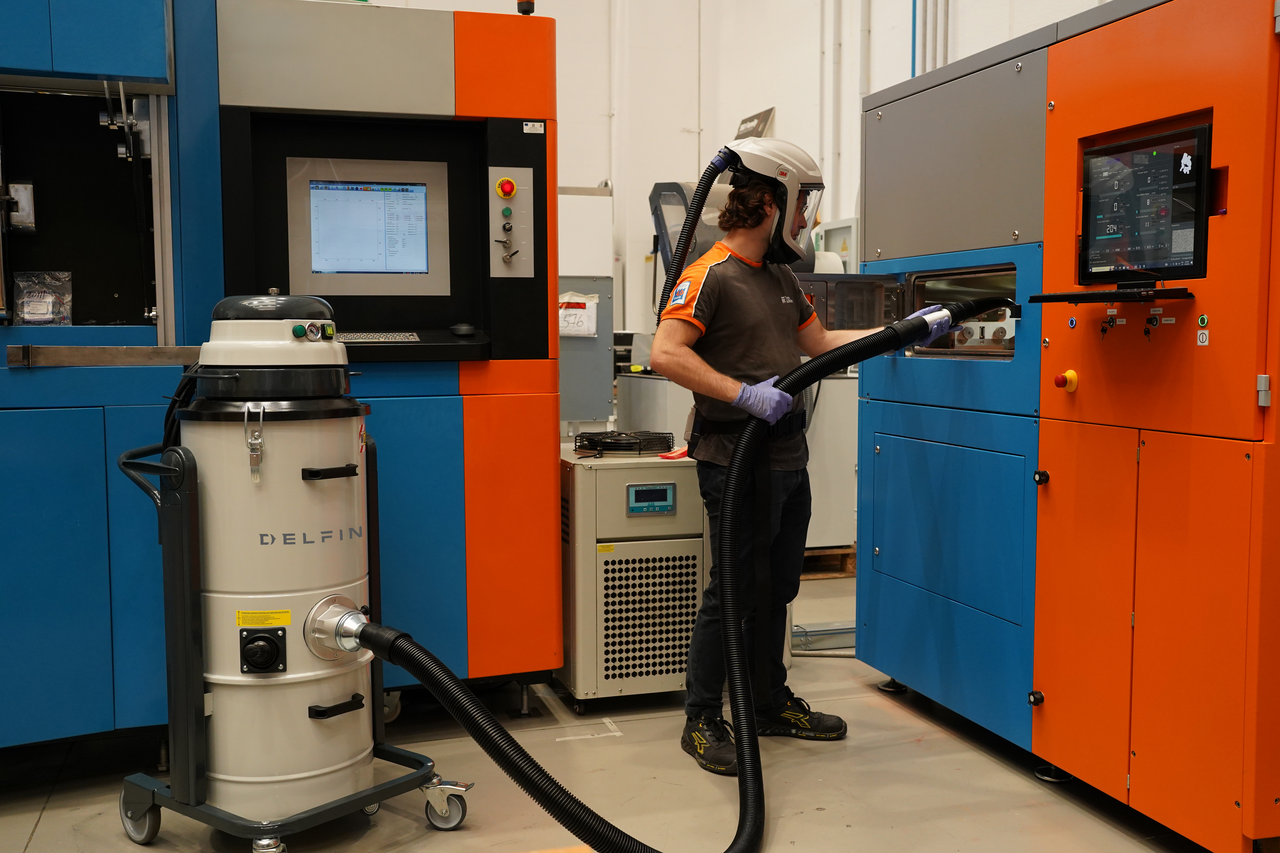
Printing is complete, but the production process isn't yet complete. Before starting a new cycle, you need to clean the 3D printer by removing any residual dust from the chamber, clean the printed components, and prepare the workstation.
Cleaning is a critical step in additive manufacturing processes using metal and polymer powders. Proper waste management limits particle dispersion, reduces operator exposure, and helps prevent contamination.
Not all powders can be treated equally: materials like aluminum and titanium can be highly reactive. The choice of equipment must consider the material, process, and work environment.
Why cleaning your industrial 3D printer is essential
In powder bed technologies, such as SLS and metal laser melting, some of the material is not incorporated into the part. After printing, opening the chamber, removing the parts, and transferring the powder are all steps in which the material can disperse.
Cleaning includes three complementary activities:
- Removing dust from the print chamber and preparing for the next cycle.
- Dust removal of components, including accessible surfaces and geometries.
- Cleaning of machine surfaces, equipment and surrounding area.
Each activity requires accessories and collection methods to be evaluated separately. It is helpful to reduce unnecessary open transfers, especially with fine, combustible, or reactive dust.
For a general overview of the management of hazardous agents in the workplace, please consult the EU-OSHA resources .
How to clean the print chamber, components, and work environment
Removing dust from the chamber
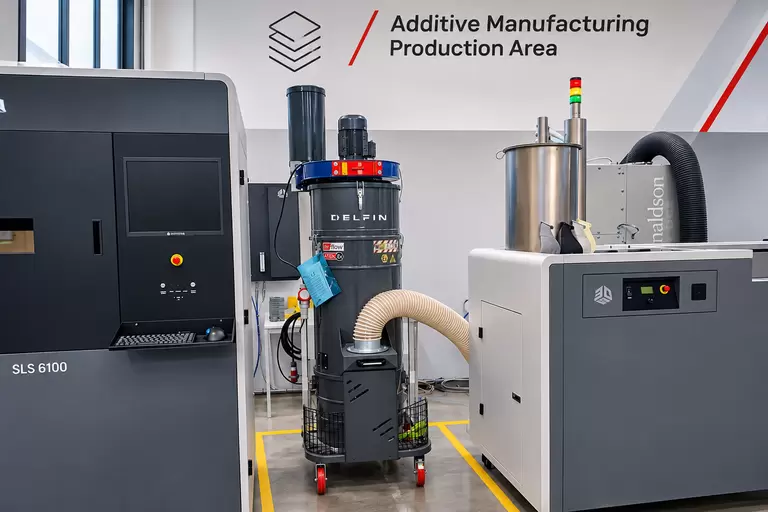
The amount of material to be extracted, the accessibility of the chamber, and the printer configuration determine the extraction system. Access conditions must comply with the manufacturer's instructions: working with the chamber open and through a glove box are not equivalent.
Delfin PES (Powder Extraction System) systems are designed for dust extraction. In Gastight configurations, the inert gas acts as a carrier and is recirculated in a closed circuit. The choice depends on the material and the machine's integration requirements.
Dust removal of components
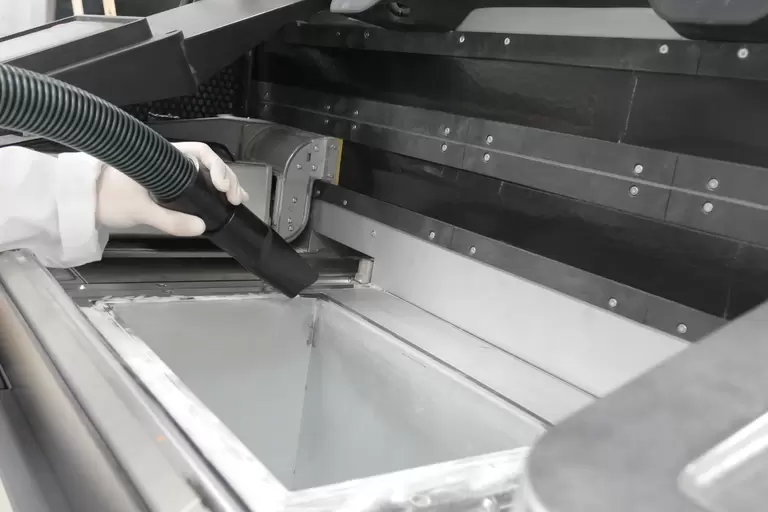
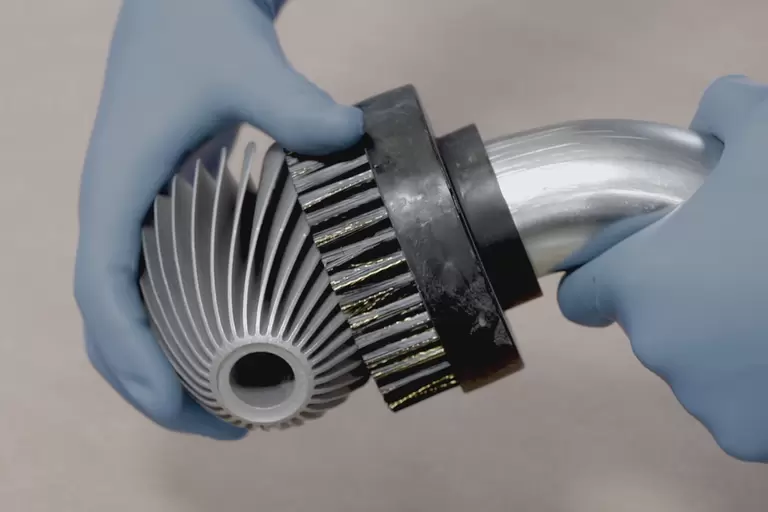
After removing the primary material, residues may remain on the surfaces and inside channels, cavities, or lattice structures. Depowdering prepares the component for subsequent processing. Vacuuming accessible residues alone does not guarantee complete cleaning of the internal geometries: dedicated technologies and checks may be required.
Cleaning the workstation
In addition to the print chamber and components, work surfaces, floors, and equipment where dust settles must also be cleaned. The goal is to remove residues without dispersing them into the environment: compressed air blowing and dry sweeping can resuspend them. Cleaning methods, including any use of liquid products, must be compatible with the reactivity of the dust and comply with the machine manufacturer's instructions.
Which Delfin industrial vacuum cleaners should you use for 3D printing dust?
The choice begins with the safety data sheet and the actual characteristics of the powder. It's necessary to evaluate combustibility, reactivity, particle size, quantity, area classification, recovery or disposal, and the possibility of integrating it with the printer.
Suitability concerns the entire system: vacuum cleaner, filters, piping, conductive accessories, grounding, and collection methods. The presence of a HEPA filter alone does not prove suitability for fire or explosion protection.
Delfin INERT vacuum cleaners for reactive metal dust
For specific reactive metal powders, Delfin offers a range of INERT extractors that collect the material in a bath of inerting liquid selected for the application. This method is distinct from dry or closed-circuit extraction intended for potential powder recovery.
Available configurations include the DM2 1/3D INERT, a powerful dual brushless motor vacuum cleaner for Zone 22 applications, and its superior model, the DM2 1/2D INERT, for Zone 21 applications, depending on risk assessment and material compatibility.
For high flow rate requirements, the ZFREV AP 1/3D 560 INERT K2 inert dust collector is also available . The choice of a model cannot ignore the technical verification of the specific dust.
An application example where it is possible to understand in detail how Delfin aspirators are used is the Delfin case study on the aspiration of metal powders from 3D printers , which examines the use of our INERT solutions integrated into process machines directly from the manufacturer (OEM).
Filtration and ATEX classification
Configurations can include antistatic and HEPA H14 class filters, but the system must be selected based on the overall risk. In classified areas, equipment appropriate for the installation area and the characteristics of the dust must be used.
For further information on the obligations relating to explosive atmospheres, please consult Directive 1999/92/EC .
Delfin solutions for cleaning and dust management
Post-print cleaning is an integral part of additive manufacturing: dust extraction, component dedusting, and workstation maintenance must be designed as connected steps.
Delfin supports companies in analyzing operations, materials, and production conditions. Specialized technicians evaluate collection methods and integration options with existing machinery and systems to identify a solution consistent with the process.
Learn more about Delfin solutions for industrial additive printing and the in-depth study dedicated to Formnext 2026 .
Tell us about your application: our specialists will help you identify the most suitable extraction system for your material and production process.