
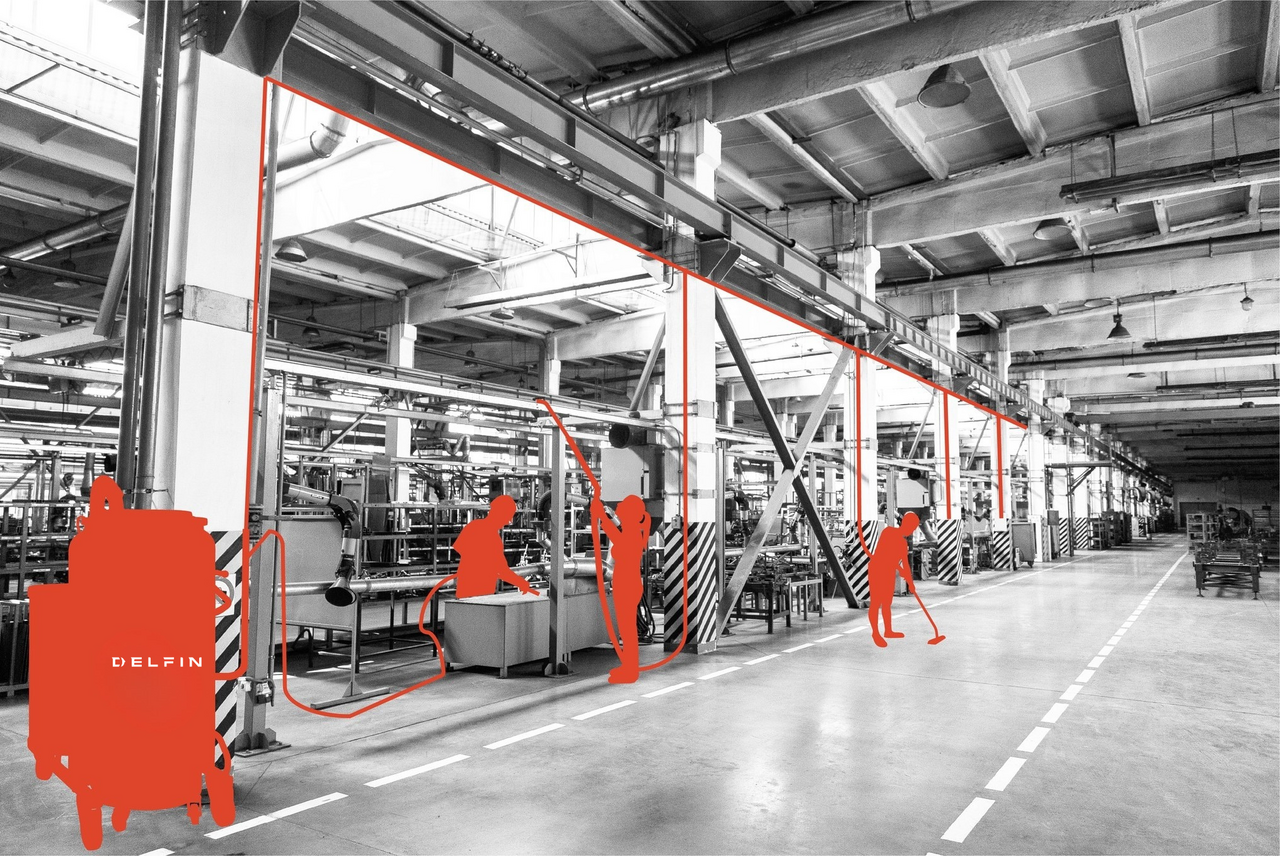
Managing industrial dust isn't just a matter of keeping the shop clean. Accumulation, airborne dispersion, and operator exposure impact safety, machinery efficiency, and production continuity. When dust is generated in multiple locations, over long distances, or during continuous operations, a centralized extraction system (CVS) offers the structured and stable control that occasional interventions cannot provide.
We design and build these systems based on the material, process, and actual operating conditions of the facility. In some contexts, dust is also combustible and the area is classified as potentially explosive: in those cases, the system is configured as ATEX, consistent with the classification established by the employer. Let's first look at the risks, then how a CVS addresses them, and finally, when an ATEX assessment comes into play.
The risks of ineffective dust management
Accumulation and dispersion
Dust settles on surfaces, around machinery, along production lines, and in less accessible areas. If not intercepted at its source, it re-suspends during production, maintenance, or cleaning. The problem is exacerbated when emissions affect multiple workstations: manual intervention removes visible material but does not prevent the formation of new accumulations or the spread of finer particles.
Operator exposure and contamination
Inhalable dust remains suspended in the air and reaches the respiratory tract; the nature of the risk depends on the material, its particle size, and the conditions of exposure. This can also lead to contamination of surfaces, products, and equipment. In composite materials, residual fibers can compromise processing and damage sensitive electronic components; in the food industry, dispersion directly impacts hygiene and product quality.
Wear, maintenance and production downtime
Dust and debris accelerate wear on belts, valves, filters, and machinery, and abrasive residues—such as some mineral dusts—require solutions designed for heavy workloads. Ineffective management results in increased manual interventions, cleaning stops, and unscheduled maintenance. In this sense, dust control is part of operational continuity, not simply departmental order.
When a CVS is the right solution
A CVS is a fixed system that conveys dust, waste, and materials through a network of pipes to a centralized collection point. It is the recommended choice in three common situations.
Multiple extraction points and long distances. In facilities with many machines or workstations to serve, constantly moving mobile extractors becomes inefficient. A fixed network covers the distances and can operate on individual or simultaneous points, depending on the process needs.
Continuous production of dust and residues. When material is generated frequently, in large quantities, or in continuous production cycles, single-point collection simplifies unloading, disposal, and possible recovery. The system can integrate automatic filter cleaning and unloading systems, reducing manual intervention and maintaining operational efficiency.
Localized extraction at critical points. Source extraction intercepts the material before it disperses or settles on equipment. The CVS can be connected directly to the machines or served by outlets distributed throughout the work areas. The location of the collection points, however, must be carefully considered based on actual emissions: increasing the system's power is pointless if the outlets, pipes, and flow rate are inconsistent with the process.
How a CVS controls dust risk
Centralized collection and less manual handling
Conveying material to a single collection point organizes waste management, reduces travel between stations, and limits operator contact with the collected material. Hoppers, containers, and unloading systems are configured based on volumes and disposal methods; in intensive processes, continuous unloading increases the system's autonomy.
Advanced filtration
The filter system is chosen based on the dust's hazardous nature, particle size, and applicable exposure limits. Configurations can include class M primary filters and, where required, high-efficiency H14 filters. A cyclonic pre-separator retains a significant portion of the material before the main filter: this protects the filters, reduces wear, and reduces maintenance frequency.
Automatic control and business continuity
A CVS comprises a central vacuum system, piping network, filter unit, collection system, and control panel. Sensors and automatic devices monitor operation and coordinate filter cleaning and discharge. The configuration must be calibrated based on shifts and frequency of use: a continuous process system requires different criteria than one used only for periodic cleaning.
How we evaluate and size a system
Material, process, and collection points. The design process begins with the material's characteristics—powder type, density, particle size, quantity produced, and any presence of moisture, oils, or combustible substances. The number, location, and method of use of the collection points are then identified: it's crucial to know whether the collection points will operate individually or simultaneously, and whether the system will serve process collection, cleaning, or both.
Flow rate, vacuum, and filter surface area. Flow rate is the amount of air needed to transport the material; vacuum overcomes the resistance of the network; the filter surface area must be sized based on the quantity and type of dust. Air velocity must prevent deposits in the pipes without generating excessive pressure drops: an incorrect value reduces efficiency, increases consumption, or encourages internal accumulation.
Piping, separation, and discharge. The diameter of the piping depends on the flow rate, required velocity, network length, and material characteristics, while bends, branches, and differences in level also affect performance. Separation is also assessed on a case-by-case basis: fine powders, abrasive materials, or large volumes may require pre-separators, specific filters, automatic cleaning systems, and dedicated discharge methods.
When ATEX assessment comes into play
Not all dusts pose the same risk: a dust can be harmful to health, abrasive, or contaminating without being combustible. An ATEX assessment only becomes relevant when the material's characteristics and operating conditions can generate an explosive atmosphere. It is therefore incorrect to state that every CVS must be ATEX.
In the presence of combustible dust, it is necessary to assess whether the material can form an explosive cloud and whether there are ignition sources. The technical factors to be examined—grain size, concentration, minimum ignition energy, process conditions—refer to both the installation environment and the various internal sections of the system. The configuration is not defined by the name of the material alone.
One point needs to be clarified precisely. Zone classification is the employer's responsibility as part of the risk assessment. Our role is to acknowledge this: based on the classification and operating conditions communicated to us, we define the appropriate technical configuration for the installation area and the material being extracted—the central unit, control panel, sensors, exhaust systems, piping, and filtration are assessed as part of a single system. In other words, we provide the solution; we do not classify the area for the client.
An application case: different needs in the same plant
In a newly built cement plant, we integrated four centralized extraction systems in the bagging, cement grinding, coal grinding, and silo areas. Fixed piping allowed us to cover long distances and organize collection at critical points; the systems were sized for continuous workloads and fine, abrasive materials.
The requirements, however, were not identical in every department. Cement dust required, above all, robustness, containment, and abrasion resistance. In the coal grinding area, however, the presence of combustible material and the environmental classification required a dedicated ATEX configuration—adopted only where the operating conditions and material required it. The plant itself thus demonstrates why the same solution is not automatically applied to all departments.
Signs that indicate a technical inspection
Buildup reappears after every cleaning. If dust and debris quickly return to surfaces, under machinery, or along lines, capture is likely insufficient; frequent use of compressed air also resuspends particles instead of removing them. An inspection identifies sources, dispersion points, and appropriate capture methods.
Multiple locations require continuous extraction. Numerous machines, long routes, simultaneous use, or continuous shifts are all good indications for CVS. Before choosing a system, however, the performance required at each location must be determined: the number of nozzles installed does not necessarily correspond to the number of nozzles that can be used simultaneously.
There are concerns about the combustibility of dust. If the process generates metallic, organic, or other potentially combustible dust, the characteristics must be clarified before configuring the system. The assessment includes the aspirated material, area classification, ignition sources, and collection methods. Only then is it determined whether an ATEX solution is required and what characteristics it should have.
From the presence of dust to the correct technical solution
Occasional accumulation requires a different response than continuous dust production distributed across multiple workstations. CVS becomes relevant when collection, transportation, filtration, and collection must be coordinated in a stable manner: the decision is based on the actual conditions of the department, the materials, and the production continuity objectives.
Before choosing a system, it's a good idea to check dust sources, intake points, distances, simultaneous uses, filtering system, and exhaust methods. If combustible dust or hazardous areas are present, the assessment also includes applicable ATEX conditions. Request a technical analysis of your department: together, we'll determine whether a CVS is needed and which configuration can properly manage the risk.
FAQ
When there are multiple extraction points, long distances, large volumes of material, or continuous operation is required, mobile vacuum cleaners remain suitable for limited operations or occasional workstations. The choice depends on the department's organization, not just the amount of visible dust.
No. A CVS is configured as ATEX when the assessment identifies combustible dusts and conditions capable of generating explosive atmospheres, taking into account any classified areas. A harmful or abrasive dust is not automatically combustible: each application requires specific verification.
Material data (grain size, density, volumes to be vacuumed), layout, distances, diameter or characteristics of the inlets, number of simultaneous points, and shift patterns. In cases of potential explosion risk, information on the combustibility of the dust and the ATEX classification of the areas, as defined by the employer, are also required.