The project was developed for an international group leader in the production and distribution of dry construction systems, flooring, plasters and insulating materials , with hundreds of factories worldwide.
The Israeli plant needed an effective solution to manage the drywall dust generated during production. Cleaning activities had to be carried out for many hours a day, with accumulations that could reach several hundred kilograms per day.
In the production of drywall construction materials, drywall dust extraction is an essential component of the process. It not only affects the orderliness of the premises, but also directly impacts operational continuity, production quality, and operator safety.
The project was developed for the Israeli plant of an international group specializing in the production and distribution of drywall systems, flooring, plasters, and insulation materials . The plant had to handle large quantities of gypsum dust generated daily during manufacturing.
The accumulations could reach several hundred kilograms per day. Their removal could therefore not be entrusted to sporadic interventions: it required an organized, constant process appropriate to the scale of the phenomenon.
Cleaning that is necessary for many hours a day
Cleaning operations had to continue for many hours throughout the day. This intensive use required a system capable of maintaining consistent performance throughout the entire shift, even with large quantities of material.
The challenge wasn't simply collecting the settled dust.It needed to be continuously vacuumed, moving between different production areas and intervening where accumulations could interfere with normal operations.
Why does plasterboard dust compromise production continuity?
Drywall processing generates large volumes of extremely fine particulate matter. If drywall dust is not removed regularly, it gradually spreads throughout the facility and settles on machinery, surfaces, and work areas.
In a plant with high production rates, this widespread presence can complicate daily operations and require frequent cleaning. Dust management thus becomes a factor closely linked to plant availability and the ability to maintain consistent production.
The spread of fine dust in the production environment
Gypsum dust does not remain confined to the point where it is generated. The finest particles tend to spread throughout the environment and reach areas other than those directly affected by the process.
As the hours pass, the material gradually settles. Without effective suction, cleaning becomes more challenging and the production environment becomes difficult to maintain.
Accumulations on machinery and risk of downtime
Continuous dust accumulation on machinery can interfere with its proper operation. When dust builds up excessively, it may be necessary to temporarily interrupt production for cleaning.
Every stoppage affects process continuity and reduces the plant's production capacity . An adequate extraction system must therefore help limit buildup before extraordinary interventions become necessary.
Risks to quality, health and safety
Industrial dust management isn't just about plant efficiency. The spread of particulate matter can also impact the quality of the finished product and the working conditions of operators.
The main critical issues identified included:
- the accumulation of dust on machinery and surfaces;
- interruptions necessary for cleaning operations;
- the risk of contamination of the finished product;
- prolonged exposure of operators;
- the daily management of hundreds of kilograms of material.
The risk of contamination of the finished product
The widespread presence of fine dust increases the risk of material settling in work areas where it shouldn't be present. This environmental contamination can interfere with the process and compromise the consistency of the final result.
Keeping production areas clean therefore also means protecting product quality. Vacuuming plays a preventative role, allowing for the removal of spilled material before it can affect other stages of the process.
Exposure of workers to fine dust
Fine dust dispersed in the air or deposited in environments poses a potential risk to personnel throughout their shift. Prolonged exposure can have health implications and contribute to the onset of occupational diseases.
Reducing the presence of particulate matter allows for healthier and more controlled operating conditions, in line with the goal of protecting workers and complying with the plant's safety standards.
Requirements for a drywall dust extraction system
The volumes to be collected and the duration of the work required an industrial drywall vacuum cleaner suitable for intensive use. The system had to guarantee consistent performance for many consecutive hours and handle hundreds of kilograms of dust daily, without any drops that could slow down cleaning operations.
The solution also needed to be robust and easily transportable between different areas of the plant. This combination of durability and mobility was essential for addressing the areas affected by accumulations, keeping the environments under control, and supporting the continuity of the production process.


Plasterboard processing generates large quantities of fine dust which negatively impacts the workflow and operator safety:
- Reduced efficiency : Dust settles on machinery and surfaces, causing temporary production stoppages.
- Product quality : Increases the risk of contamination of the finished product.
- Workplace safety : it generates a risk of occupational diseases and compromises the cleanliness of the environments.
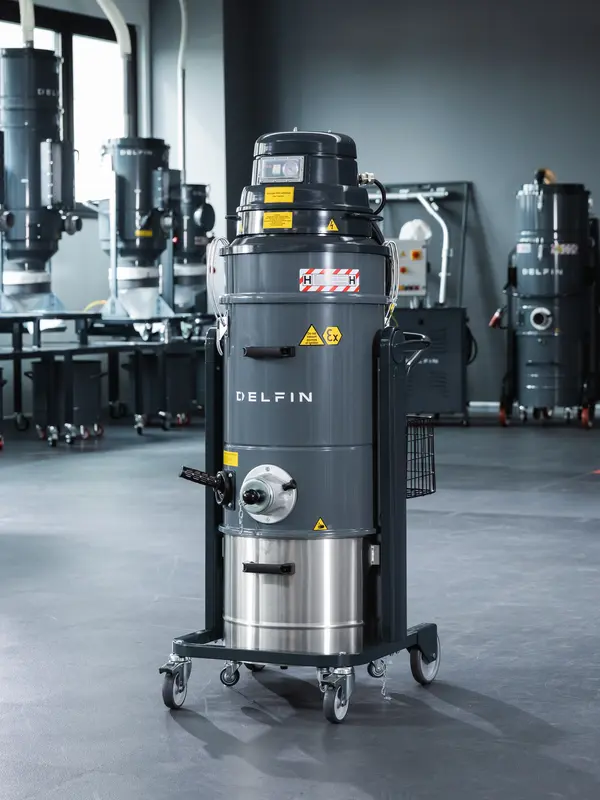
Three-phase vacuum cleaners DG70EXP
Three-phase industrial vacuum cleaners model DG70EXP were installed, specifically designed for heavy-duty applications in the construction sector. The machines allowed:
- High performance : effective cleaning of large volumes of fine chalk dust.
- Continuous cycle : prolonged use throughout the entire production shift without any drops in performance.
- Versatility : easy movement between different areas of the plant thanks to the trolley design.
- Filtration : Safe management of volatile dust typical of drywall production.
Benefits obtained
- Business continuity : drastically reduce the risk of production downtime thanks to constant and deep cleaning.
- Optimized maintenance : better management of residual dust and speeding up routine maintenance activities.
- Healthy environment : reduction of contamination present in the environments and improvement of safety standards.
- Overall efficiency : optimizing the time dedicated to industrial cleaning and recovering productivity.
Are you looking for a solution for construction dust management?
You may also be interested in