
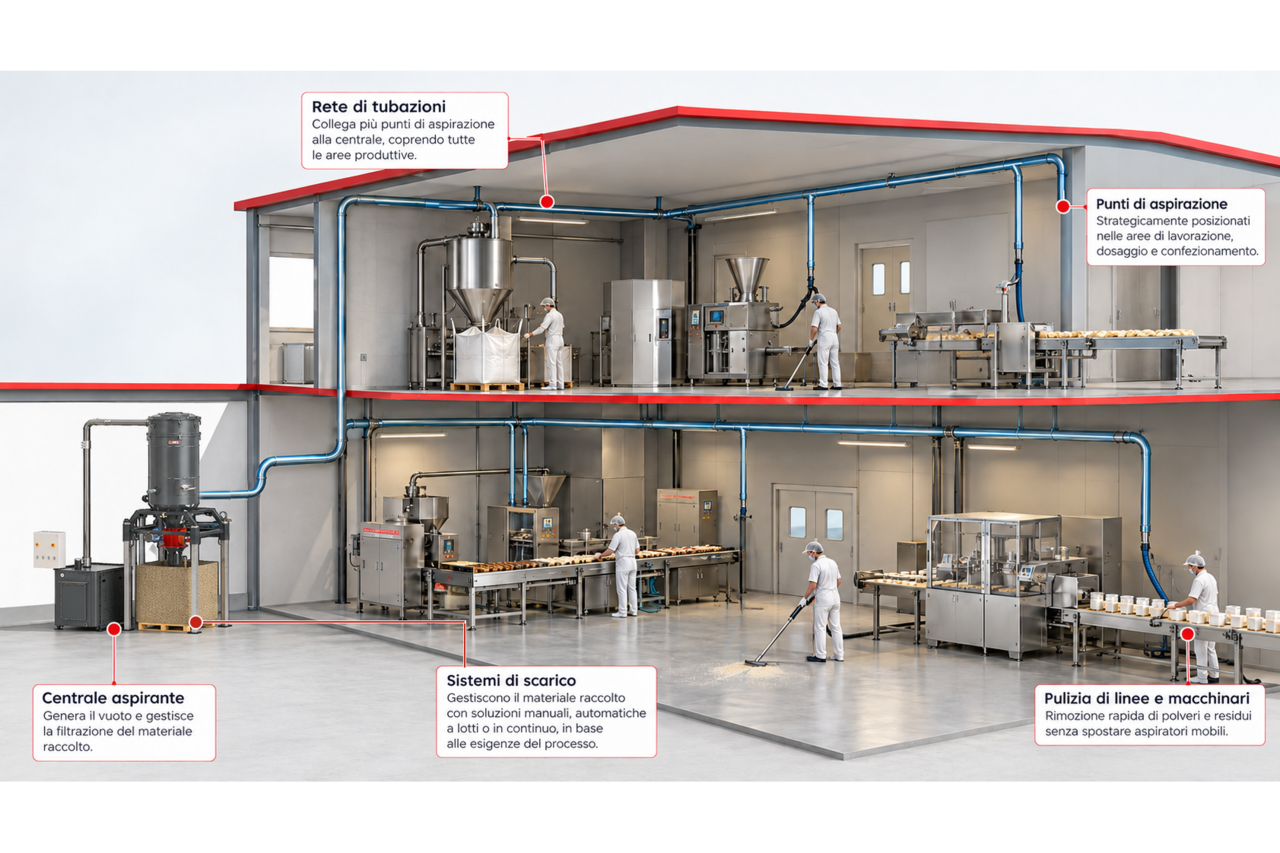
In a food processing plant, flours, sugars, starches, and other dust can accumulate in various places throughout the plant: along production lines, near processing machines, and in raw material handling areas.
When there are numerous workstations to keep clean, mobile vacuum cleaners may require constant movement from one area to another. Managing interventions becomes more complex, especially when the lines are distributed across multiple departments.
How do you organize industrial vacuuming when cleaning needs span multiple production areas? A centralized system can be the solution to making vacuuming an integral part of the plant's organization.
When is it best to install a centralized vacuum system?
The choice of a centralized system is particularly interesting when the extraction needs are distributed across multiple areas and are repeated in the company's production cycle.
For example, consider a plant where dust accumulates near dosing machines, in mixing areas, and along packaging lines. Intervening with mobile equipment might mean constantly moving industrial vacuum cleaners and organizing operations based on the different workstations.
The advantage of installing a The advantage of a centralized industrial vacuum system is that you can connect multiple points of use to a single central vacuum unit through a network of fixed pipes. Operators can use the outlets provided in the work areas, without having to constantly move a vacuum cleaner from one workstation to another.
How does a centralized food powder plant work?
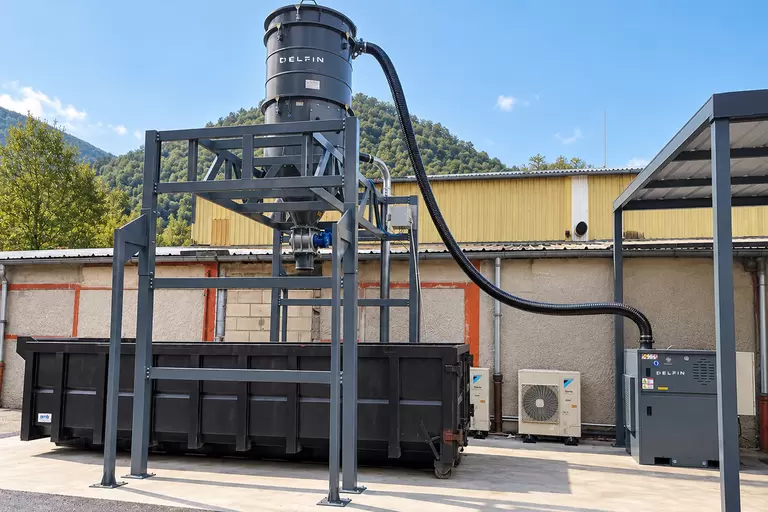
A centralized system is composed of a central vacuum unit, a filtration and collection system, and finally a network of pipes that reaches the various production stations.
The design must take into account the type of material being aspirated, the distance between the points of use, the required flow rates and the number of stations that must operate simultaneously.
For example, in a company that processes powdered ingredients, the system can be configured to reach multiple areas of the plant, facilitating the extraction of residues in areas where cleaning needs are concentrated.
The advantage is not only in having a single power plant: it is the design of the entire network that determines the effectiveness of the system .
After vacuuming, how should the collected material be managed?
When there are multiple vacuum cleaners, dust and debris inevitably accumulate in the container, emptying it can require frequent manual interventions and interrupt cleaning or production activities.
With the CVS, the unloading system becomes a single , integrated system, simplifying this operation with manually operated, batch-based, or continuous automatic solutions. Delfin offers systems such as slide gates, butterfly valves, and double valves, selectable based on the collected material and process requirements.
Managing the collected material requires less manual intervention . If the continuous discharge is designed to maintain vacuum, the material can be discharged without interrupting the suction .
Flours, sugars, and combustible powders: why safety is essential.
In the food industry, some organic dusts can present an explosion risk when dispersed in air under certain conditions.
The design of a centralized system must therefore also consider the characteristics of the dust and the risk assessment of explosive atmospheres. Where applicable, the choice of solution must take into account the classification of the areas, the components used, and the protective measures required for the entire system.
To learn more and understand if the materials you are using are hazardous, consult the ATEX Directive 2014/34/EU , relating to equipment and protective systems intended for use in potentially explosive atmospheres, and Directive 1999/92/EC , relating to the protection of workers at risk from explosive atmospheres.
We'll help you choose the best solution for your facility. How do you choose the best solution for your facility?
There's no identical centralized system for every food company. To identify the right configuration, you need to start with the operating conditions and production needs.
In particular, it is necessary to evaluate:
- Materials to be vacuumed: flours, sugars, starches and other powders may require different configurations.
- Distribution of stations: number, position and distance of suction points.
- Frequency of use: method and duration of interventions, including whether the operations are simultaneous.
- Filtration and collection: solutions suited to the characteristics of the material and maintenance procedures.
- Safety: Any risks associated with combustible dust and applicable installation requirements.
A correct initial analysis allows us to identify a solution consistent with the production process, avoiding sizing the system based solely on the factory floor space.
Do you think your food production requires a centralized system?
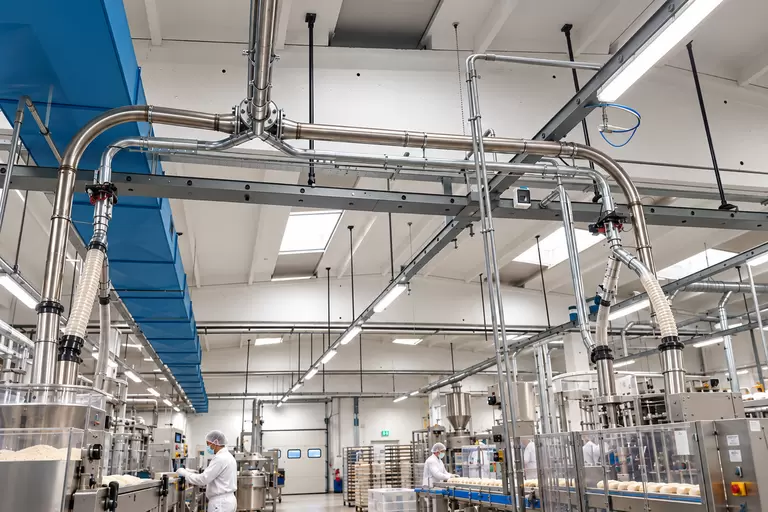
Are flours, sugars, and other dust accumulating at multiple points in your production process? A centralized system can help you manage extraction at multiple locations through a single system, designed specifically for your production process.
Tell us how you work and what materials you need to vacuum. The Delfin team will help you identify the best solution for your facility.
Centralized extraction systems: pay attention to the new Machinery Regulations
Designing a centralized extraction system must also consider the safety requirements applicable to machinery and its integration into production processes. From January 20, 2027, Regulation (EU) 2023/1230 on machinery will apply , replacing the Machinery Directive 2006/42/EC. This is an important reference for those designing or integrating industrial extraction solutions, assessing the risks and safety requirements relevant to the specific system configuration.