
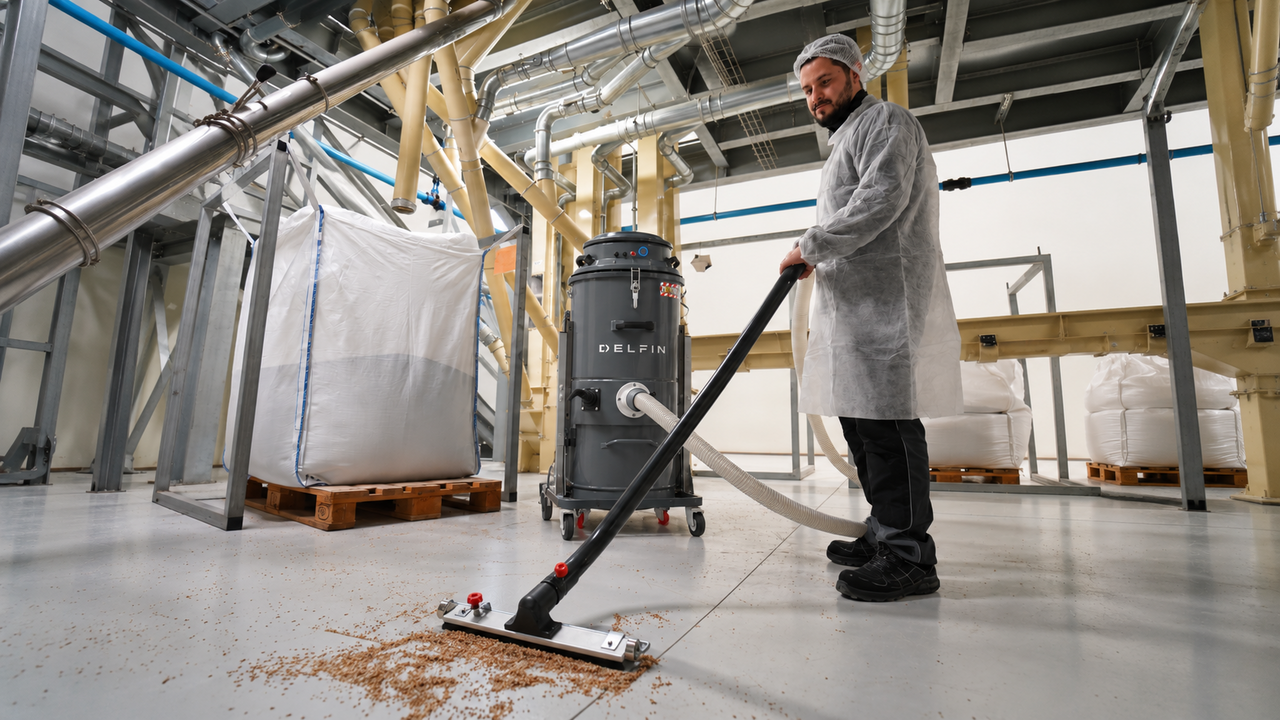
A package of flour that breaks during handling. A cloud of dust rises while loading a hopper. Packaging scraps accumulate near the packaging machines. These are everyday situations in many food processing plants, but each requires a different solution.
In the food industry, cleanliness isn't just about the appearance of the environment. It means managing processing residues, preventing contamination, and contributing to production continuity.
Therefore, choosing industrial vacuum cleaners for the food industry means first and foremost understanding the production process. From raw material storage to oven cleaning, Delfin develops vacuum solutions for the food industry based on the needs of individual applications.
Raw material storage: cleaning starts in the warehouse
It all starts with the arrival of the raw materials. Bags, boxes, containers, and pallets are constantly moved, and during these operations, small accidental spills can occur.
Flour, sugar, grains, and packaging residues can accumulate on floors, under shelves, and in spaces between items. Even when quantities are limited, regular cleaning is essential to keep storage areas tidy and accessible.
In these situations, the most practical solution is often a mobile industrial vacuum cleaner for general cleaning , versatile and easy to move. Thanks to specific accessories, it allows you to collect residues in hard-to-reach areas, simplifying daily tasks.
Delfin's DM3 EL is a solution for these tasks. Equipped with three single-phase motors, a large collection container, and an integrated Dustop filter cleaning system, it manages dust and solid residues, facilitating warehouse cleaning and maintenance.
However, when the risk assessment highlights the presence of potentially explosive atmospheres or the need to extract combustible dust, it is necessary to choose equipment suitable for the area classification or the desired application. The MTL 301 1/3D Z22 , for example, is an ATEX-certified industrial vacuum cleaner for applications with combustible dust in Zone 22, to be selected based on operating conditions. The new ACD-classified models are also extremely interesting solutions if you need to extract combustible food dust such as flour, coffee, and sugar in non-ATEX-classified environments.
Flour Spill: Catching Dust Before It Spreads
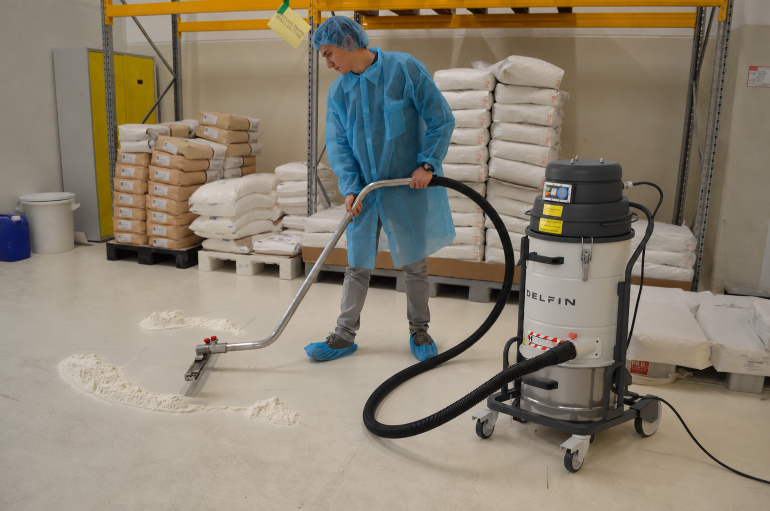
The problem changes when raw materials enter the production process.
When emptying flour sacks, loading hoppers, or dosing operations, lighter particles can become airborne. This creates dust clouds that reach surrounding surfaces and workstations.
In this case, simply collecting the material deposited on the ground is not enough. It is necessary to intercept the dust directly at the point where it is generated .
This is where the industrial dust collector comes in. Unlike a vacuum cleaner designed for cleaning surfaces, the dust collector uses a high air flow rate to capture suspended particles through localized extraction systems.
An example of the Delfin range is the Z22 ZFR EV AP 560 K2 dust collector , designed for the management of fine dust even in environments classified as ATEX Zone 22.
Flour and sugar, in fact, can generate explosive atmospheres under certain conditions. The correct choice of system must therefore also consider the risk assessment and the area classification.
When the need involves multiple cleaning points throughout the facility, it may also be worth considering a centralized system. One example is the Delfin case study on centralized extraction of flour and food powders , conducted for a confectionery company.
Packaging: when waste interferes with production
Once processing is complete, the product moves on to the packaging stage. However, even here, residues can be generated that require specific management.
Cutting plastic film, trimming packaging, and other packaging operations produce waste that can accumulate near the mechanical parts of packaging machines.
If not removed regularly, this waste can hinder cleaning operations and interfere with line operation.
The solution is to vacuum up the waste directly during its production , rather than intervening only when it has accumulated.
The AS series industrial vacuum cleaners, such as the AS 20 model , can be integrated on board the machine to collect cuttings and waste in a special nylon bag.
In this way, suction becomes an integral part of the packaging process, facilitating waste management and contributing to the regularity of operations, avoiding blockages or machine downtime.
Cleaning the facility: don't forget the high surfaces
Cleaning a food facility isn't limited to the floors and machinery.
Just by looking up, you can spot surfaces that are often difficult to reach: beams, pipes, overhead structures, ducts, and the tops of systems.
Over time, these areas can also accumulate dust and residues that risk falling onto the areas below.
To intervene without systematically resorting to aerial platforms or scaffolding, Delfin offers a system of accessories for industrial cleaning at height.
Thanks to the lightweight modular carbon fiber poles and dedicated accessories, operators can reach numerous elevated surfaces by working directly from the ground, with a suitably configured industrial vacuum cleaner.
The goal is to make cleaning difficult areas more accessible by integrating it into the plant's regular maintenance and hygiene programs. Delfin also offers various industrial cleaning and maintenance solutions , designed to address the various critical issues in production environments.
Cleaning industrial ovens: a dedicated solution for cooking residues
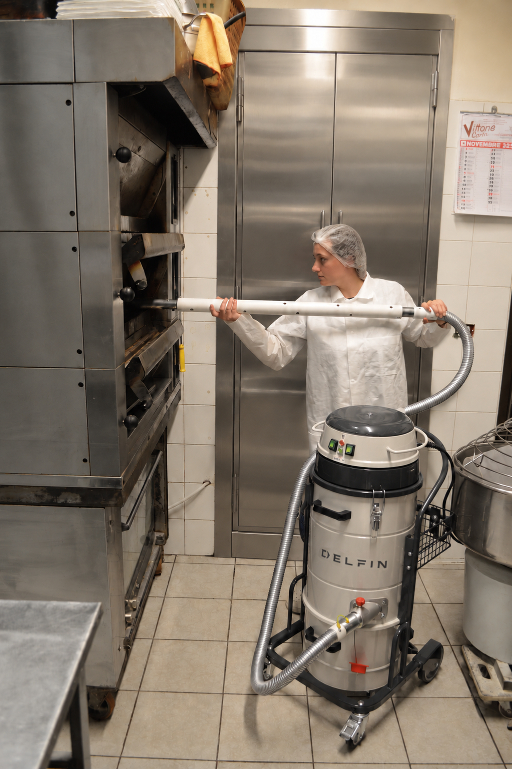
In bakeries, pastry shops, and factories that use industrial ovens, cleaning presents additional challenges.
After baking, crumbs, flour, ash, and food residue can remain inside the ovens. The depth and high temperatures of ovens make it difficult to reach every area with traditional tools. Some ovens still use wet rags, which risks cross-contamination and the growth of bacteria, mold, or other pathogens.
To meet these needs, Delfin offers the MTL 202 DS OVEN industrial vacuum cleaner , developed for cleaning professional ovens.
The high-temperature-resistant NOMEX filter and the specific oven kit , with heat-resistant accessories and dedicated extensions, allow residues to be collected even in the deepest areas, while respecting the temperature limits set for the various components.
Cleaning thus becomes easier and more targeted, helping operators prepare the equipment for subsequent operations.
From single need to solution: the Delfin approach
From storage to the finished product, each stage of the food industry presents different challenges. To address them, simply choosing a vacuum cleaner based on power or size isn't enough.
It is necessary to evaluate the material to be collected, the point where it is generated, the environmental conditions and the methods of use.
It is precisely from these questions that Delfin's work begins.
Thanks to its experience in industrial extraction, Delfin supports companies in identifying the most suitable technology and configuration, from mobile solutions to dust collectors, to systems integrated into production lines.
Because every process is different, and the suction solution must be designed around its actual needs.
New machinery safety regulation: Do you know what changes from January 20, 2027?
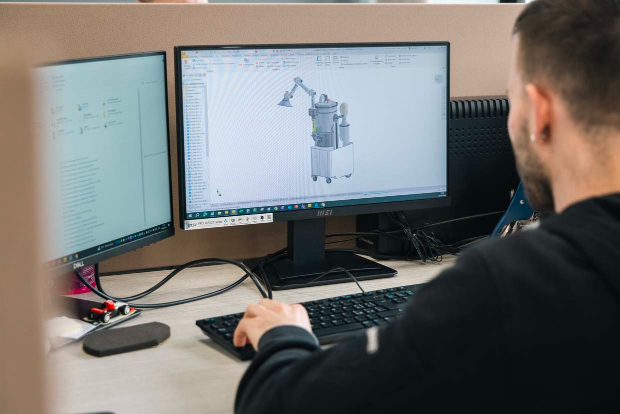
From 20 January 2027, the new Machinery Regulation (EU) 2023/1230 will apply, introducing updated requirements for the safety of industrial machinery.
Delfin is ready to address this regulatory evolution , designing and manufacturing industrial suction solutions in compliance with applicable safety requirements, to offer its customers reliable machines that comply with the relevant regulations.
Need to buy a new industrial vacuum cleaner or want to know which solution to choose? Trust Delfin specialists to help you find the machine best suited to your production needs.